Exertional Rhabdomyolysis: An Underappreciated Concern in the Fire Service
Posted: September 16, 2026
- 1 min read
- Find similar articles:
- Health and Safety
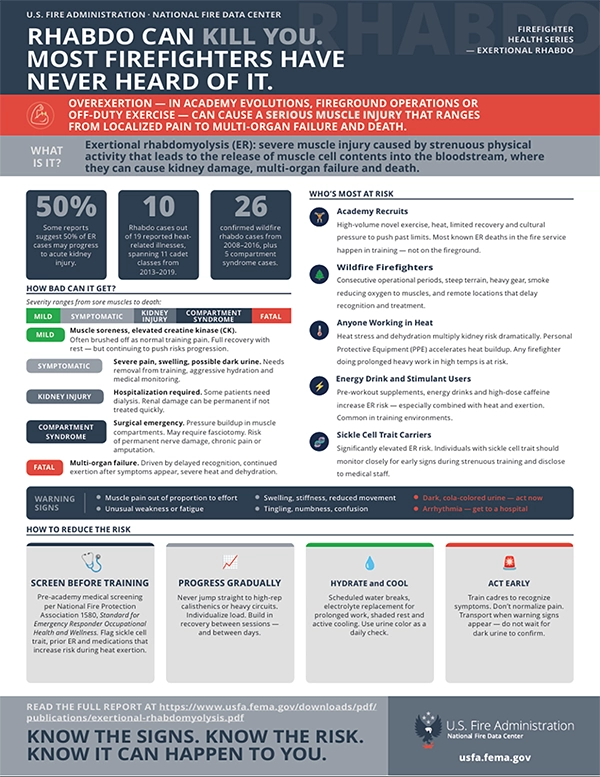
Exertional Rhabdomyolysis: An Underappreciated Concern in the Fire Service: A Fire Service Health Risk Leaders Should Not Overlook PDF
Firefighters train and operate in some of the most physically demanding environments in public safety. Whether on the fireground, in a training academy or during wildfire operations, firefighters routinely perform strenuous work while wearing heavy protective equipment, often in high heat and under significant physical and mental stress. One health risk that deserves greater attention is exertional rhabdomyolysis (ER), often called "rhabdo."
ER is an uncommon but potentially serious condition that occurs when intense physical exertion damages skeletal muscle. When muscle breaks down, it releases cell contents into the bloodstream, including creatine kinase and myoglobin. In some cases, this can lead to serious complications such as kidney injury, dangerous electrolyte imbalances, compartment syndrome or even death.
While ER can affect athletes, military personnel and others engaged in high-intensity physical activity, the fire service has several risk factors that make awareness especially important.
Why firefighters are at risk
Firefighting brings together many of the conditions that can contribute to ER. These include heavy muscular work, heat stress, dehydration, limited recovery and the use of personal protective equipment that increases thermal strain.
The risk can be especially elevated during training academies, where recruits may experience long days, repeated high-intensity evolutions, physical training and limited recovery time. Recruits often arrive with different fitness levels and medical histories, which means a single standardized workload may affect individuals very differently.
Wildfire operations present another high-risk environment. Long-duration work, steep terrain, heavy gear, smoke exposure, altitude, and limited access to cooling or structured hydration can all increase physical strain. In remote settings, delayed recognition or transport may also increase the risk of complications.
ER can occur in any fire service setting, but it is more likely when strenuous or unfamiliar muscular work overlaps with heat stress, dehydration, fatigue, illness, or use of certain medications or stimulants.
A shared responsibility
ER is underrecognized, but it is not unavoidable. Firefighters, instructors, officers, medical providers and agency leaders all have a role in reducing risk.
Firefighters should understand the signs and symptoms. Instructors should apply sound training principles and watch for early warning signs. Officers should ensure policies support hydration, heat mitigation, recovery and timely medical evaluation. Organizations should treat ER as a predictable risk during high-workload, high-heat conditions.
Firefighting will always be physically demanding. But awareness, preparation and early action can help prevent a serious condition from becoming a life-threatening event. Protecting firefighter health is not separate from operational readiness. It is operational readiness.
Download and share the full report to learn more.